
IPTV vs IPTV Resellers: Understanding the Supply Chain & The Path to Profit
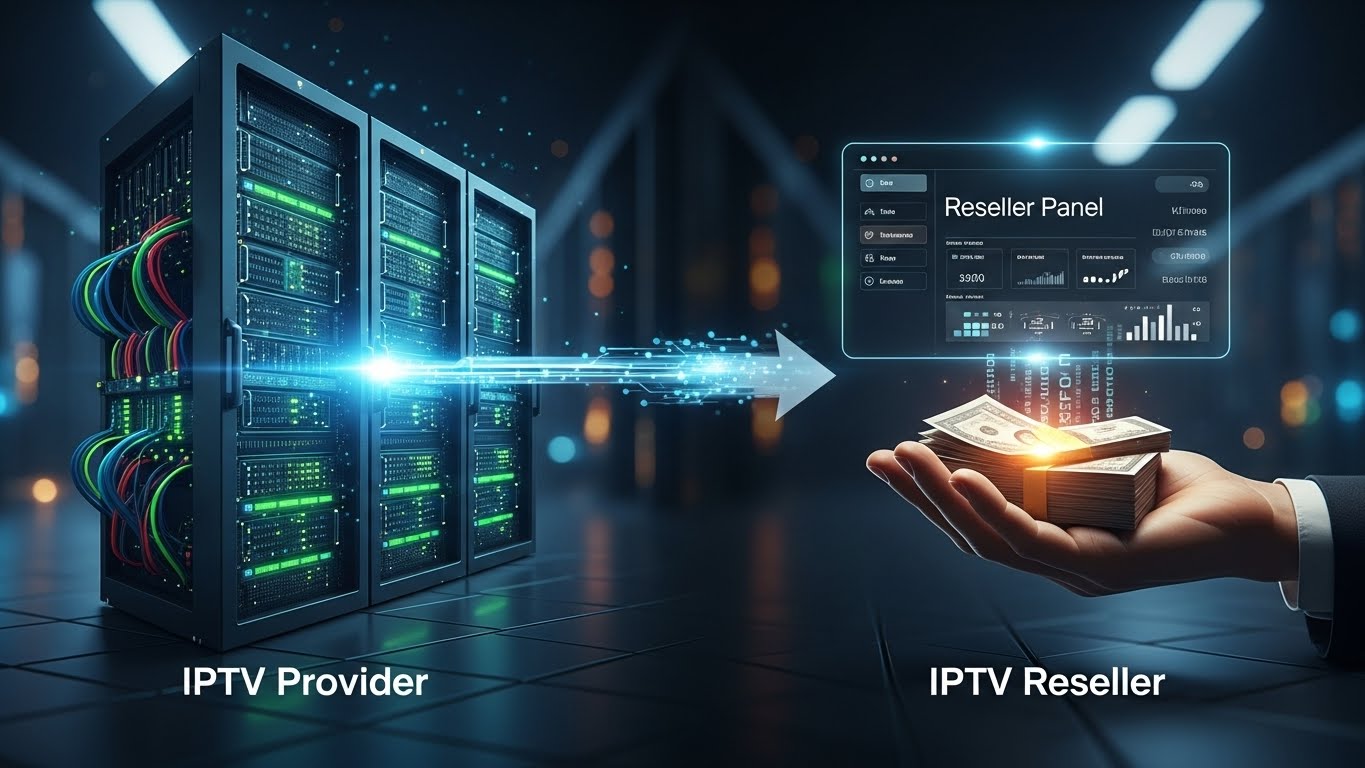
The television landscape has undergone a seismic shift in the last two decades. Gone are the days when a dish on the roof or a cable line was the only gateway to entertainment. Today, Internet Protocol Television (IPTV) reigns supreme, offering thousands of channels, video-on-demand, and interactive features delivered directly over the internet. This technological revolution has birthed a sprawling, complex, and often controversial IPTV supply chain, creating a stark dichotomy between the entities that build the infrastructure and those that sell the final product: the IPTV Provider and the IPTV Reseller.
For anyone looking to enter this lucrative market—whether as a service creator, a marketer, or even a consumer seeking the best service—understanding the fundamental differences between IPTV vs IPTV resellers is not just helpful, it’s absolutely critical. Their roles, risks, profit margins, and legal exposure are vastly different, yet they are inextricably linked in the delivery of the service.
I. The Digital Content Revolution: A Primer
What is IPTV?
At its core, IPTV is a method of distributing television content where the signal is converted into digital packets and sent over an internet connection. Unlike traditional terrestrial or satellite broadcasts, IPTV utilizes the Internet Protocol (IP) to allow for two-way communication, enabling interactive features like pausing live TV, viewing Electronic Program Guides (EPG), and utilizing video-on-demand (VOD) libraries. This market is experiencing exponential growth, driven by consumer demand for choice, affordability, and convenience.
The Core Difference: Infrastructure vs. Sales
The key to distinguishing between an IPTV Provider and an IPTV Reseller lies in their contribution to the supply chain.
- A Primary IPTV Provider is the creator and wholesaler. They invest millions in infrastructure and technology, including powerful Content Delivery Networks (CDNs) and high-capacity servers. Crucially, they are also responsible for the monumental task of content acquisition and licensing.
- A Reseller, on the other hand, is the retailer. They have virtually no infrastructure investment. They purchase credits or “lines” from the primary provider in bulk and use a web-based IPTV Reseller Panel to manage and sell subscriptions directly to the end-user. Their core competence is not technology but marketing, sales, and customer service.
Understanding this separation—the provider handling the “supply” and the reseller handling the “demand”—is the first step toward mapping out the entire IPTV supply chain.
🛠️ II. The Source of the Stream: The Primary IPTV Provider

The IPTV Provider forms the absolute backbone of the service, acting as the digital headend—the facility that gathers, processes, and prepares the television signals for transmission over the internet. Their operations are defined by scale, technology, and legal responsibility.
Infrastructure and Technology Investment
The investment required to become a primary provider is staggering. It is a world away from the reseller model, demanding not only significant capital but also deep technical expertise.
1. Content Delivery Networks (CDNs) and Bandwidth
A provider must distribute their stream efficiently across continents to avoid latency and buffering. This requires a vast, strategically located network of servers known as a CDN. The cost of bandwidth and maintaining these global nodes is one of the highest recurring expenses in the IPTV business model.
2. Encoding, Transcoding, and Headend
Incoming satellite or fiber feeds must be compressed and formatted into multiple resolutions (SD, HD, 4K) and various codecs to suit different devices (smart TVs, mobile phones). This real-time processing occurs at the IPTV Headend and requires powerful, dedicated server farms, often using hardware transcoders and encoders. Any error introduced at this stage propagates throughout the system.
3. Security and Digital Rights Management (DRM)
To protect their signal and meet any licensing agreements, providers must implement sophisticated Digital Rights Management (DRM) and encryption. This prevents unauthorized sharing and piracy, which is a constant and costly threat in the IPTV space.
Content Acquisition and Licensing: The Legal Hurdle
This is perhaps the single largest barrier to entry for legitimate IPTV services and the most important distinguishing factor in the IPTV vs IPTV resellers analysis. Legitimate providers must negotiate complex, multi-territory licensing agreements with every channel and content owner (e.g., major sports leagues, movie studios).
- Cost and Complexity: Licensing fees run into the millions, making this an impossible financial undertaking for most small businesses.
- Territorial Restrictions: Licenses often only cover specific countries, which is why unauthorized services frequently offer content that is geo-blocked in the user’s region—a clear indicator of operating outside the law.
The primary provider is therefore the one that bears the immense legal compliance and financial risk associated with running a large-scale broadcasting operation.
Stability and Middleware Management
Beyond the initial setup, a provider’s core value lies in its stability. They are responsible for the entire IPTV platform’s health:
- Middleware: The software layer that manages the EPG, VOD library, user accounts, billing, and the overall user interface.
- Server Uptime: Ensuring server uptime of 99.9% or higher to guarantee an uninterrupted streaming experience for hundreds of thousands of concurrent users globally.
- 24/7 Monitoring: Proactive monitoring to detect and resolve issues like server load spikes, Distributed Denial of Service (DDoS) attacks, and source feed failures.
💰 III. The Point of Sale: The IPTV Reseller Business Model
If the provider is the factory and warehouse, the IPTV Reseller is the shopfront. This model is the entry point for the vast majority of entrepreneurs into the streaming business due to its minimal upfront cost and focus on sales.
Defining the IPTV Reseller and Their Role
An IPTV reseller does not own or manage any streaming infrastructure, nor do they hold any content licenses. They act as an authorized (or unauthorized) distributor of the service offered by a single, or sometimes multiple, primary providers.
- The Transaction: The reseller purchases subscriptions in bulk—often called “credits” or “connections”—from the provider at a heavily discounted wholesale price.
- The Profit: They sell these individual subscriptions to end-users at a retail price, pocketing the difference. They keep 100% of the profit from the markup.
- Customer Facing: The reseller is the primary point of contact for the end-user, handling sales, payment collection, client management, and first-line support.
The IPTV Reseller Panel: The Core Tool
The entire operation of a reseller is managed through an IPTV Reseller Panel (a web-based dashboard). This tool is the backbone of their business and controls the entire lifecycle of a customer subscription.
| Feature | Description | Importance to Reseller |
| Account Creation | Instantly generates M3U links, usernames, and passwords for new clients. | High: Essential for fast customer onboarding. |
| Credit Management | Tracks the balance of purchased subscription credits (inventory). | Critical: The inventory management system. |
| Service Control | Activates, deactivates, extends, or offers free trials to clients. | High: Allows for flexible pricing and marketing strategies. |
| Sub-Reseller Tools | Allows the main reseller to create and manage their own sales network. | Scaling: Enables rapid network expansion. |
Advantages and Disadvantages of Reselling
The appeal of the reseller model in the IPTV vs IPTV resellers comparison is overwhelmingly financial and logistical:
Reseller Advantages
- Low Barrier to Entry: Start-up costs are minimal, removing the need for expensive servers, encoding hardware, or bandwidth contracts.
- High-Profit Margin: Since the cost per line is low, the gross profit margin on each sale can be very high, easily exceeding 100% per month.
- Focus on Sales: The reseller can dedicate 100% of their time to marketing, SEO, and sales efforts, letting the primary provider handle all the technical headaches.
Reseller Disadvantages
- Zero Control over Stability: If the primary provider’s servers crash, or they face technical issues, the reseller’s entire customer base is affected, and they have no technical fix.
- Sudden Shutdown Risk: Because many unauthorized primary providers operate in a legal gray area, a reseller’s entire business can be shut down overnight if the provider is targeted by law enforcement, resulting in the loss of their entire customer base and unused credits. This is a major factor in the high-risk, high-reward nature of the business.
🔗 IV. Dissecting the IPTV Supply Chain: How the Service Flows
The delivery of an IPTV service is a multi-layered process that transcends simple sales. It is a value chain where complexity decreases and accessibility increases as the product moves toward the consumer.
Stage 1: The Content Source (The Origin)
This is the broadcaster (e.g., ESPN, HBO, Sky) or the media owner that legally owns the content rights. They transmit their content via satellite or private fiber networks. This is the most regulated point of the chain.
Stage 2: The Primary IPTV Provider (The Wholesaler)
The provider ingests the content (either legally via license or illegally via signal piracy), processes it at the Headend (encoding, encrypting, organizing), and stores the VOD content. They then push these streams out to a Content Delivery Network (CDN) to handle global bandwidth demands and ensure Quality of Service (QoS).
Stage 3: The Reseller Network (The Retailer)
The provider sells access rights (credits) to a network of resellers. The reseller utilizes their panel to activate a service line for an end-user. The reseller’s interaction is purely commercial and managerial—they are activating an existing stream from the provider’s servers.
Stage 4: The End-User (The Consumer)
The consumer receives the service link (e.g., M3U playlist) from the reseller, enters it into their device (STB, Smart TV app, smartphone), and begins streaming. The stream is delivered directly from the provider’s CDN to the end-user’s device. The reseller is simply the payment and account manager.
⚖️ V. Legal and Ethical Considerations: Risk vs. Reward
The unauthorized IPTV business model operates in a precarious legal landscape, posing vastly different levels of risk for the provider, the reseller, and even the end-user.
Provider Liability: The Highest Risk
The primary provider carries the overwhelming majority of the legal liability. They are the ones directly engaged in large-scale copyright infringement by aggregating and redistributing licensed content without authorization.
- Fines and Damages: They face potential lawsuits from broadcasters, which often result in massive fines totaling tens or hundreds of millions of dollars.
- Infrastructure Seizure: Authorities can seize all their core assets, including servers, encoding hardware, and financial accounts, leading to a complete and permanent shutdown.
- Criminal Charges: Key individuals responsible for the operation face severe criminal charges, including jail time, for piracy and organized crime.
Reseller Liability: The Gray Area
While the reseller doesn’t own the infrastructure, they are knowingly profiting from the distribution of an illegal service. Their risk profile is often focused on the financial loss of their business and, increasingly, legal action.
- Loss of Business: The immediate risk is the sudden, non-reimbursable loss of their customer base and any unused credits when the primary provider is shut down.
- Prosecution for Distribution: While less common than targeting the provider, authorities in regions like Greece and the EU have begun targeting high-volume resellers and distributors for aiding and abetting copyright infringement.
- Payment Processor Risk: Resellers risk having their payment gateways (PayPal, Stripe, etc.) frozen and accounts shut down due to their activity, severely impacting their revenue stream.
Consumer Risk: An Evolving Landscape
Historically, consumers were rarely targeted. However, recent legal frameworks in Europe have led to the prosecution of end-users for accessing pirated IPTV, particularly those who use it for commercial purposes (e.g., in bars or cafes). The risk to the consumer includes fines and potential data exposure from unsecured services.
📈 VI. Business Model Comparison: Profitability & Scaling
The choice between the IPTV provider vs reseller model depends entirely on resources, technical skill, and risk tolerance.
Cost Structure Comparison
The financial outlay for the two models is fundamentally different:
| Aspect | IPTV Provider | IPTV Reseller |
| Initial Investment | Very High (Servers, CDN contracts, Licensing/Piracy costs, Headend gear). | Low (Initial purchase of wholesale credits, Reseller Panel fee). |
| Recurring Costs | High (Bandwidth, CDN fees, server maintenance, power, legal defense). | Low (Credit top-ups, website hosting, marketing/SEO). |
| Profit Model | High-volume, low-margin (per user). Profits from massive scale. | Low-volume, high-margin (per user). Profits from markup. |
| Scaling | Difficult and capital-intensive (requires continuous hardware upgrades). | Easy and marketing-intensive (requires only more customers/sub-resellers). |
The White-Label Middle Ground
A popular alternative is the White-Label IPTV model. In this setup, a service provider buys a fully branded, managed service from a larger wholesaler. They get their own branded app, domain, and management portal, offering more stability and control than a basic reseller, but still avoiding the immense technical burden and cost of being the primary provider. This option is gaining popularity as a safer way to launch an IPTV business.
VII. Deciding Your Path: Provider or Reseller?
The final choice must be pragmatic, balancing ambition against resources and skill.
Choose the Provider Path If…
- You have substantial capital ($1M+) and access to high-end technical and legal talent.
- Your goal is to build a massive, long-term, utility-scale operation (either legitimately licensed or fully committed to the high-risk, high-reward unauthorized route).
Choose the Reseller Path If…
- You have a limited budget and strong sales, marketing, and customer service skills.
- Your primary goal is quick entry into the market with high margins and minimal technical overhead.
- You accept the inherent risk of having your supply source suddenly disappear.
VIII. Conclusion: The Evolving Landscape of Digital TV
The debate of IPTV vs IPTV resellers highlights the core dynamic of the digital streaming world: one side builds the infrastructure and aggregates the content, while the other side markets and sells the final product to the consumer. Both are indispensable cogs in the current IPTV supply chain.
While the primary provider is burdened by colossal technical and legal responsibility, the reseller enjoys low barrier-to-entry and high per-sale profits, albeit with zero control over service quality and the constant risk of sudden shutdown. As the streaming industry matures and legal enforcement tightens globally, the stability and long-term viability of all players in the unauthorized market will continue to be challenged, making the choice of which path to follow more critical than ever before.
❓ Frequently Asked Questions (FAQ)
The IPTV landscape often generates confusion regarding its legality, business operation, and consumer safety. A Primary IPTV Provider is the entity that builds the complex streaming infrastructure—servers, CDNs, and encoding systems—and carries the immense financial and legal burden of securing or pirating content. This requires high capital and specialized technical expertise. In contrast, an IPTV Reseller is primarily a marketing and sales agent. They purchase access (called “credits”) in bulk from the provider and sell individual subscriptions to end-users at a markup using a simple management portal, known as a Reseller Panel. This allows for a very low barrier to entry but creates total dependency on the provider’s stability.
The legal status of a service depends entirely on content licensing. The underlying IPTV technology is legal, as demonstrated by authorized services like Hulu and YouTube TV (Source: How to Identify Legal IPTV Providers: A Comprehensive Guide – AWS). However, the vast majority of services offering thousands of premium channels for a low price operate illegally by distributing copyrighted material without authorization. The Provider assumes the greatest risk, facing multi-million dollar fines and criminal charges for mass copyright infringement. The Reseller faces the risk of their entire business collapsing overnight if their source is shut down, and increasingly, legal exposure for aiding in distribution, as evidenced by recent crackdowns on reselling networks (Source: Greek police busts illegal IPTV network, charges dozens of subscribers – Cybernews).
For entrepreneurs, the choice between IPTV Provider vs IPTV Reseller hinges on resources and risk tolerance. Becoming a provider requires deep technical knowledge and millions in investment, offering the highest potential for scale and independence but the highest legal liability. Becoming a reseller requires minimal capital and focuses entirely on sales and customer acquisition, making it a quick, high-margin entry point, but one that sacrifices stability and control over the service quality (Source: The Complete Guide To IPTV Reseller Programs: Building A Profitable Streaming Business – NEX OTT IPTV SERVICE | NEXOTT.NET).
Consumers should be wary of services that offer suspiciously low prices or lack transparent business and contact information. While a VPN (Virtual Private Network) can help protect privacy and mask activity from your ISP, it does not make an illegal IPTV service legal, as the core act of accessing the pirated material remains copyright infringement (Source: The Hidden Dangers of Illegal IPTV Services: What You Need to Know – Fact UK). The best choice for long-term safety is to opt for officially licensed streaming platforms, or to understand the associated risks of service interruption, data exposure, and potential legal consequences.
Finally, the market is continually evolving. As detailed in current IPTV trends, the industry is seeing tighter regulatory enforcement, a shift toward personalized content using AI, and a demand for 4K/8K streaming. These technical and legal pressures are pushing both providers and resellers to either legitimize their content sources or face the increasing efficiency of global anti-piracy coalitions like the Alliance for Creativity and Entertainment (ACE) (Source: Operator of Illicit Cyberlocker Convicted in Landmark Decision Following ACE-Supported Action).
Interested in IPTV Lifetime?
Get premium IPTV lifetime access with 25,000+ channels and 26,000+ movies. Contact us to learn more about our lifetime IPTV subscription plans.
View IPTV Lifetime Plans